
How I Test AI Tools: My 12-Point Review Method
At a glance
- Every review begins with a defined job and comparable tasks.
- Scores summarize evidence and trade-offs, not a universal truth.
- Meaningful product changes should lead to dated corrections or retesting.
Readers who want to understand how Abdessalam evaluates tools and interprets scores.
You want a laboratory benchmark or certification standard rather than an editorial workflow method.
Test context: The twelve-point editorial method used to frame tasks, compare outputs, count corrections, assess trust, and publish limitations.
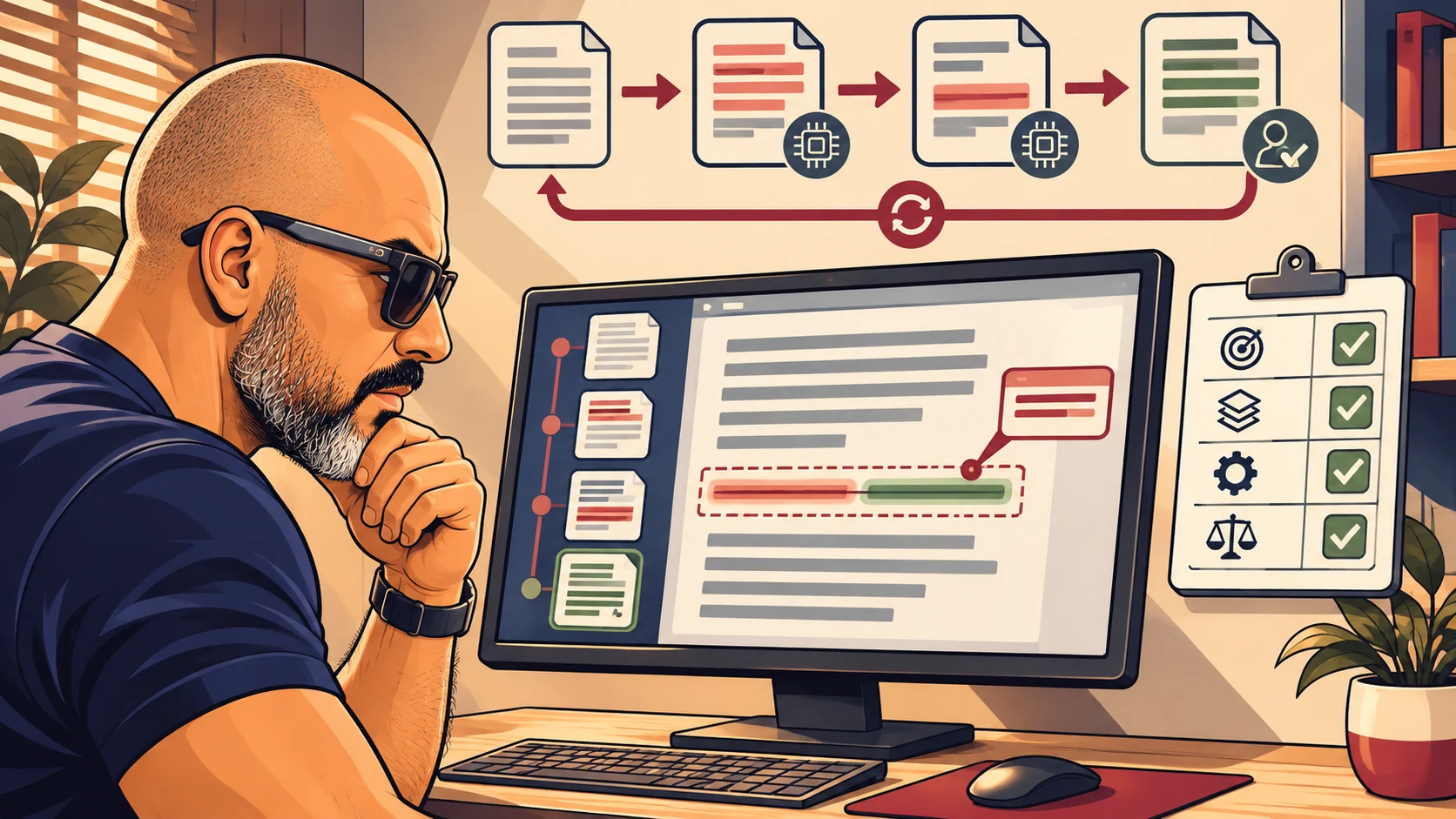
A review method should make a recommendation easier to challenge. This 12-point scorecard tests the full path from a real task to a reviewed, usable result.
1–3. Define the job before opening the tool
First, name the repeated task in one sentence. Second, define the person doing it and the final audience. Third, write the minimum useful result and the failure that would make the output unsafe or unusable.
These three points prevent a common review mistake: rewarding a product for capabilities that do not improve the chosen job.
1. Repeated task
What specific work happens often enough to justify a tool?
2. User and audience
Who operates the product and who depends on the result?
3. Success and failure
What must improve, and what error is unacceptable?
4–6. Build a test set that exposes differences
Use at least three examples from real work: one ordinary case, one dense or ambiguous case, and one edge case. Keep the input and evaluation criteria consistent across comparable products. Repeat important tests to see whether quality is stable or accidental.
Include source material whenever the real workflow includes it. A product that performs well from a polished prompt may behave very differently with a messy document, incomplete context, or conflicting instructions.
7–9. Measure control and correction
Test whether you can revise the result without restarting, inspect or verify sources, export the work in a useful format, and recover when the tool misunderstands the task. Count the minutes spent correcting the result, not only the seconds spent generating it.
Also observe whether the product fits where the work already happens. A slightly weaker generator can be the better tool if it removes copying, preserves context, and makes review clearer.
10–12. Check trust, value, and exit
Review the current privacy controls for the account and plan you will actually use. Identify the sensitive data that should never enter the system. Then calculate the complete recurring cost and the workflow or subscription the product replaces.
Finally, test the exit. Can you export useful work? Is there a fallback if the service changes, the price increases, or an integration disappears? A tool is easier to trust when leaving it is possible.
| Stage | Checks | Evidence |
|---|---|---|
| Define | Task, user, success/failure | A one-page test brief |
| Test | Normal case, dense case, edge case | Saved inputs and outputs from repeat runs |
| Control | Revision, sources, export | Correction time and recovery notes |
| Trust | Privacy, accountability, failure modes | Approved data boundary and review owner |
| Value | Total cost, replacement, exit | A monthly cost and fallback decision |
Turn the evidence into a score
Weight output quality at 30 percent, control and speed to value at 20 percent each, and trust and value at 15 percent each. Publish the best-fit user and the reasons someone should skip the product beside the number.
The score should make the evidence easier to scan. It should never replace the evidence or pretend that every user has the same risk, budget, and workflow.
Article update history
- September 10, 2026: Added a concise summary, audience guidance, test context, and related practical resources.
Discussion

Community discussion
Join the discussion
Start here: What did this change—or confirm—in the way you work?
Share what you tried or add a useful correction. Be specific and kind.
Discussion guidelines
- Share direct experience when you can.
- Challenge ideas without attacking people.
- Do not post private information or promotional links.
What did this change—or confirm—in the way you work?
Add to the discussion
Sign in to join the discussion.